Showing posts with label etiquette. Show all posts

Sunday, 20 September 2015

Tip me if you can! - Good services without tips

We all love getting the recognition we deserve when doing a good job at work, and most of us would accept tips whenever the opportunity presents itself. Here in Australia tips are usually reserved for service orientated tasks and the situations in which tips are expected may vary. For example, you might not always tip when ordering your morning coffee, despite the tip jar unless you’re a regular and are having a good day. But when catching a cab and having a nice chat with the driver or having a business meeting in a fancy restaurant you may feel more inclined to tip – and it’s perfectly acceptable. However in Japan (and in many Asian countries) tipping someone for their good service isn’t as easy and effortless as you would expect it to be.

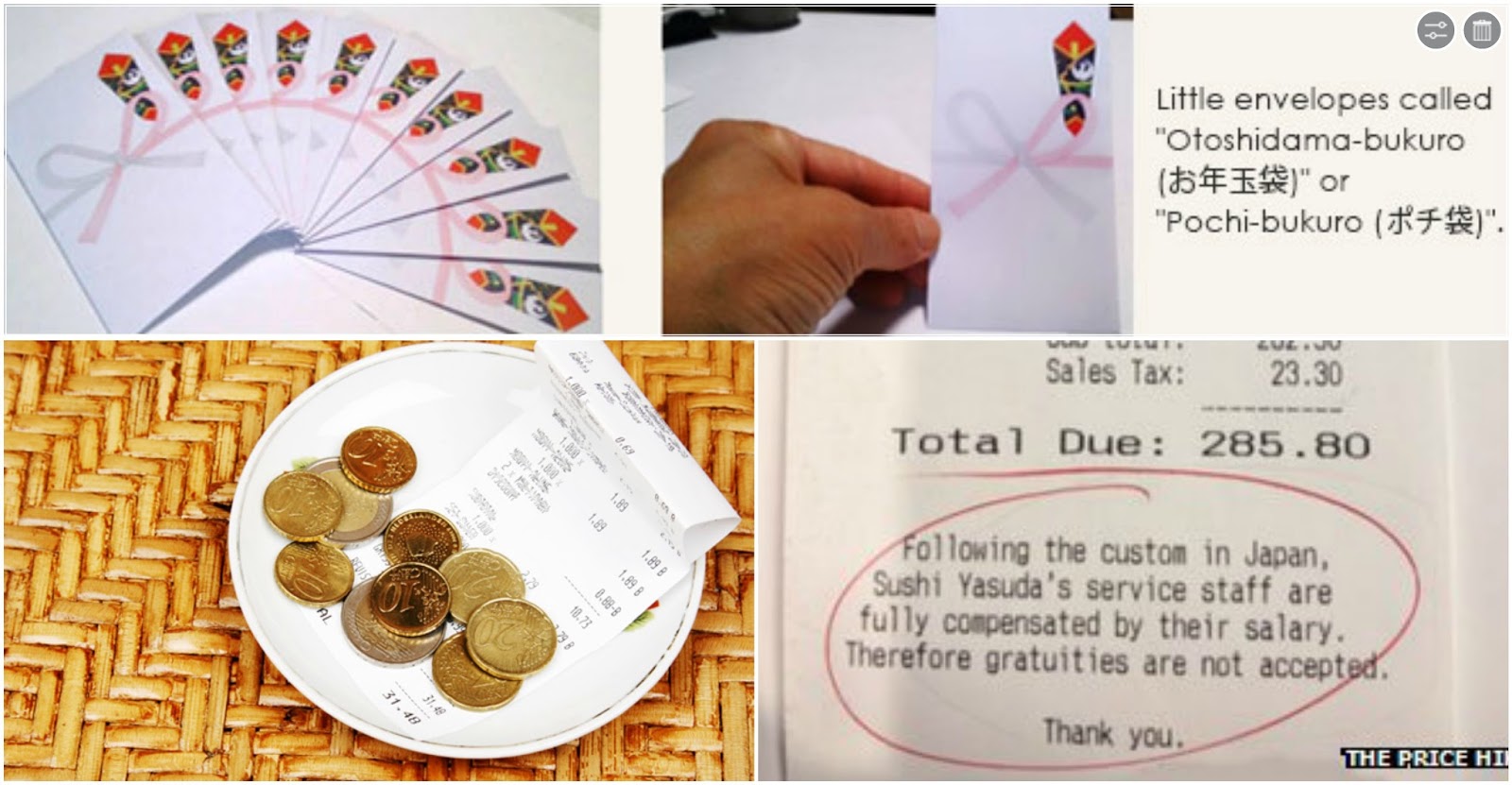
The Japanese believe that good service is the standard (as it should be) and so they embrace that customers should not pay extra. The custom of tipping is a bizarre one to them, because as the saying goes ‘The customer is king’. However if you really feel that your host deserves a tip, you may place the tip in a small envelope called otoshidama-bukuro or pochi-bukuro and offer it in this way. And to further express your gratitude - why not tell them? You can say ‘kore wa kimochi desu’ which roughly translates to 'I appreciate you' or in this instance, 'your service'. However in most cases if you were to leave the cheque on the table along with a tip, you just might be seeing your waiter chasing you down. So good luck finding an average and honest Japanese person that would even think of accepting your tip.
 In addition, like any business environment, competition with others which have similar quality and price level, differentiation is important. Restaurants and hotels focus on improving services for customers. On the other hand, competitors also develop services to win over customers so this makes synergistic effect on better services.

Friday, 18 September 2015

Onsen - Taking a Dip!

Japanese Onsen (Natural Hot Spring)
Occasionally we all love a good soaking  in the tub just to relax and break away from the routine showers and daily rushes, but in Japan it’s on a whole new level. Or rather an older one - a much older one. Japan is known for many hot springs and the Japanese have embraced them since the early 1600’s. The abundance of this natural geothermal resource is the very definition of tranquillity, relaxation and socialization. Onsen is the Japanese word for ‘natural hot springs’ and the resorts that been built around them. There is believed to be over 2,500 onsen and many have been preserved because Japanese people love taking a dip in them. It is strongly believed that onsen wield health benefits as they are naturally composed of a plethora of minerals – which also have their own curious properties.


Onsen are a special place to socialize with others, and unlike the usual spas, pools, hot tubs, or even beaches you may be used to going to, Japanese onsen have similar yet slightly more peculiar rules. It is usually frowned upon not to fully disrobe – meaning yup you guessed it – if you’re not getting nude, you sure are being rude! But before you worry too much, just remember that this is a part of their culture and that there are some onsen resorts which are private and cost a little more. Japanese love taking a dip as regular as once a month to twice a week.

Pushing the social etiquette aside, you can find onsen with black, blue, green, smoky-white, blood-red, and rustic-brown coloured waters which derive from the variations of those fantastic minerals. But don’t hesitate to try it just yet – the minerals are all safe enough to soak in. Of course those coloured onsen are usually based on the terrain they are found in – and that applies to their respective minerals too.
Blood-Red_Smoky-White_Rustic-Brown_Black_Blue Osen
Mountainous terrain usually holds the best views to relax while in a hot spring. Those onsen in the mountains usually contain sulphur and are pretty much the most common type of hot spring in Japan. Rotenburo-onsen is roughly translated to outdoor hot springs.

Green Onsen - Delicacy Hard Boiled Eggs
The numerous health benefits include the aiding of circulatory, digestive, or neurological disorders to muscular, joint or skin problems. But that’s not the curious part per se. A half hour session will both relax you and tire you out as  it supposedly consumes the same amount of energy as running 1,000 meters at full speed, and bathers are advised to rest sufficiently and replenish fluids after bathing. Some of the resorts offer hard boiled eggs hot spring style...and it is delicacy! It is no wander the Japanese have a knack for inventing great things! They are always so relaxed and rejuvenated! 

Check out these links for more detailed information on Onsen:


Saturday, 12 September 2015

Bowing Etiquette – Are you doing it right?

The Saikeirei
Have you noticed that in Japan they bow differently in particular circumstances and each of these have different meanings? This gesture is likely to be used as greeting, showing respect to people or apologizing, ranging from a slightly nod of the head to deep bend at the waist.

When you were in higher position than others, u would probably feel that people talk to you more politely, they may bow deeper than normal and maybe order the same food you do at the restaurant. It sounds new to you, right? It is because not only Japan, but almost all Asian cultures, we have societal ranking, and we rely on that to behave appropriately. This is practiced in both daily life and business situations.

If you planned to join the working environment in Japan, a 45 degree bow of the upper body (called Saikeirei) is the thing you have to do when your boss gets angry at you. Moreover, this could be used in situations you need to apologize and show regret. 

In regards to bowing in business context, I would like to mention a bit how they exchange the business cards. You have to give both hand and do as the diagram.
You might have noticed that in Asian cultures expressing your thanks verbally or greeting someone with a simple ‘Hello’ doesn’t account for the majority of the people (especially in those Japanese classic films from a decade ago). Instead, normally a slightly nod of the head does the trick. Take me as an example, this morning a gentleman offered me his seat and so I slightly nod my head to express my gratitude and smiled.

To sum it all up, it is great if you know how to bow and do it naturally, otherwise if you can’t get the hang of matching the bow to the occasion....no worries. The Japanese do not expect foreigners to do so. However, if you don’t know it, just don’t do it. Don’t put yourself in this ridiculous situation.

President Obama and Emperor Akihito

President Obama didn’t know whether he should shake or bow, then he ended up with a bow-handshake. Thankfully this little mishap in November 2009 with the Emperor of Japan, Akihito, was completely forgivable and laughable distant memory.