Showing posts with label Japanese Culture. Show all posts

Friday, 9 October 2015

Manga and Anime

Manga is Japanese comics which are normally printed in black and white while Anime is Japanese animation with diverse of colour, movement and sounds that bring anime to life. Anime ( ア ニ メ), the word "animation" means "cartoon" also known under the name Japanese animation, as the Japanese animated film. Many people mispronounce this word. It is pronounced as ‘ani-may’ often misread as ‘an-eye-m’. When you hear "anime," images of large eyes, funny and colourful hair, and peculiar fashion come to mind. Like the more internationally renowned anime series Pokémon is One Piece, one of the longest running anime series was derived from manga written by Eiichiro Oda. Most visitors to Japan simply skim the surface of manga and anime by visually appreciating the characters which pop up wherever you go with no real knowledge of who they are. However, a little research into this fantasy world can enrich your time in Japan as your knowledge of characters will create instant common ground with Japanese people you may meet and you will find yourself actively searching for and spotting the characters you know. 

If you do decide to dive deeper into these vast worlds then be careful: once you are in it is very difficult to find your way out and before you know it, you may be considered (or even call yourself) an otaku. Anime, like drama, including a lot of different genres (action, comedy, melodrama, adventure). Currently "anime" occupies 60% of the cartoon was produced worldwide. In Japan, anime is mainly on television (in Japan, most of the channels are private). The anime series aired on TV often found seasonal (season), known as the TV series, each half season usually includes 12 episodes (episodes), so the 12-episode TV series often (half season) or 26 set (one season), or 52 sets (two seasons). There are individual so long as InuYasha anime (167 episodes), Doraemon, or Naruto, and Bleach newest. 

Anime often aired at midnight, on the famous channel TV Tokyo, TBS. Having premiered on TV channels, production companies often give voice to anime in English and released DVDs in foreign markets in order to earn more profit. Japan is the only country where the audience is often go to theaters to watch the cartoons shown on screens (called Movie). These films may have a completely new storyline (like Princess Mononoke, and Spirited Away), or sometimes just a film stripped of a TV series (Movie Shakugan no Shana Rahxephon or content exactly the same TV series, but was shortened to 90 minutes). Movie studios most famous anime Studio Ghibli. Also, the anime can have "OVA" (Original Video Animation), usually of about 3 or 4 episodes.

Further information:

Wednesday, 7 October 2015

Origami

Origami (折り紙) means paper folding in Japanese. In Edo period, origami started being popular among common people. Then, it has become an art form which has been passed down through several generations.  The principal purpose is to change a flat square paper into a finished object by folding it.  Modern origami style doesn’t usually include cutting or markings on the paper.  The object can be animals, birds, fish, flowers or other shapes. Indeed, learning origami is mostly so easy that even very young children can make in a few minutes. In Japan, at one time origami was taught in schools but today, children are generally taught origami at home. 

Actually, origami can bring children mathematical interest because of its symmetric shape and develop insights along with passing down traditional art form. People celebrate national holidays with colourful origami decorations made by the family. On children's day, children make colourful paper carp as a carp recognized to swim upstream, against the current. This symbolizes vitality of children. On Tanabata day, The Star Festival is celebrated. Origami stars decorate bamboo branches. The most well-known and popular origami object is the crane. It has been created by several generations thanks to its ease. Almost every origami guide book has how to make the crane.  

Paper crane has become the international symbol of peace. In Japan almost every child has learned how to make the crane at least once. Some people try to make tiny paper cradle to show off dexterity. Interestingly, you will see a bunch of paper cradles at patient’s rooms in a hospital. It is called Senbazuru (千羽鶴) which means a thousand of cradles. It has the belief that senbazuru brings curing of illness. Therefore, a patient gets a thousand of paper cradles piled up created by his family or friends even though it takes much time to complete.

Monday, 5 October 2015

Shinto

Shinto Shrines
Shinto (神道) means the way of the gods. It is the ethnic religion of Japanese people rooted 6th century B.C.E. along with Buddhism. Shinto does not have a founder, sacred text like the bible nor official doctrine. It has contributed to develop unique Japanese attitudes and sensitivities as well as distinct Japanese consciousness. Shinto worshipers are supposed to get peacefully along with both nature and other humans. That’s why Shinto have existed in good balance with other religions. Gods of Shinto are called kami (神). They are sacred spirits which form nature, such as mountains, rain, wind, trees, rivers and even geographic regions. Therefore, people worship nature so that they think it has gods inside itself. Humans become kami after death and are admired by their descendants. In this regard, kami have the abstract forces in nature, not like the gods with human shapes having clear power found in Western religions. There are lots of Shinto shrines which are regarded as the homes of kami. Practitioners throw one coin like 5 yen toward wooden box called saisen (賽銭). Then, they have things to do, bowing twice, clapping hands twice and then bowing once again. 

This behaviour means that people show respect for kami by bowing twice and they summon kami to clap hands. Then, they prey or wish anything like good health or academic achievement. After that, they show appreciation and send kami back to nature by bowing once. Paper fortunes called O-mikuji (おみくじ) are available at shrines. People rely on O-mikuji to predict the chances of succeeding their dreams, of marriage, good health, etc. When they get bad prediction, commonly, they fold up the strip of paper and tie it to a pine tree or a wall of metal wires. Actually, pine tree (松 matsu) and the verb 'to wait' (待つ matsu) sound the same in Japanese, so the bad luck will stay at the pine tree attached the paper.
Good Fortune Note
For a more detailed inquiry into this topic visit these great sites:

Sunday, 4 October 2015

Japanese Names and Titles

Do you know any Japanese names? Most Japanese names are composed of first name and family name. Different thing from Australia is that family name is followed by first name. In that sense, first name turns to ‘last name’ as middle names aren’t commonly used. As a matter of fact, family names vary. In Japan, Sato, Suzuki, Takahashi, Tanaka and Watanabe are the most common family names. Actually the family names have meanings come from locations, nobles and nature. For instance, one of our bloggers, Kohei’s family name is Nishimura (西村) standing for ‘western village’ as Nishi (西) means west and Mura (村) means village.

In terms of first name, parents name new baby as they like. First names usually include positive meanings like wish, love, elegance, intelligence and so on.  Kohei (康平) consists of two words, representing Ko (康) as good health combined with hei (平) implying wish for world peace according to his parents. As parents can give any name for baby, problems has occurred currently. Here is an example. A baby is named Pikachu (光宙) as his parents like Pokémon. It sounds lovely name, but when it comes to workplace, he might be looked down by the boss or even colleague because it’s unusual name and sounds undisciplined.
People in Japan commonly put one of several honorific suffixes at the end of names to address each other except when they are close. San (さん) mostly can be appropriate as it implies gender- neutral. On the other hand, kun (君) is only applied for males while chan (ちゃん) is for kids or females. In most elementary schools, teachers put san on every student’s name whenever they call in order avoid gender discrimination.


Wednesday, 30 September 2015

Tea Ceremony

“Chanoyu” – A Traditional Art

The origin of tea ceremony is from drinking green tea and Buddhist belief in China from fourth century to the eighth century, what is then transformed during different periods of time to become a traditional art of Japanese people. They hold different types of tea ceremony which depend on the time of day, season of the year or in some specific occasions. It could be a tea ceremony for early-morning summer, or to celebrate the first use of the portable brazier in the year. The styles of preparation for the tea ceremony is also vary based on season or the formality of events. Japanese Tea ceremony is not a drinking tea meeting or else, it is a spiritual experience that includes harmony, respect, purity and tranquility. Therefore, there are a lot of rules to prepare and take part in the ceremony. 

An authentic example would be guests have to wait at the waiting room until the host done the preparation. Then they have to wash their hands and mouths from water in a stone basin to purify. They have to get in the tea room or tea house through a small gate in order to force them bow while they entry the room, the host will give back a silent bow. Then they have a range of steps and rules to really enjoy the tea. Depend on informal or formal they will serve guests with sweets and then tea or a full three course meal with sake and then tea. To become master of the art of Japanese tea ceremony, it takes years to learn and practice at tea schools. People have to learn common hosting duties, how to enter and exit the tea room probably, appropriate behavior when handling or drinking from the tea bowls.

For more information check out these links below:


Monday, 28 September 2015

Ninja

The conspicuous covert warriors known as Ninja (忍者) specialized in unconventional warfare. Otherwise known referred to as shinobi (meaning those who act in stealth) had been around as early as the eleventh century. This was around the age of the samurai venturing through and well beyond the sixteenth century. Unlike the Samurai the Ninja were not given an honourable image because of their mercenary class skill level and expertise in said warfare. Samurai warlords often would seek the assistance of the Ninja hidden in the remote villages of Iga and Koka. Now these villages serve as museums in which original buildings and training grounds still exist.

Ninja specialized in infiltration, sabotage, and assassination of samurai feudal lords. Ninjutsu is an art form referring to the many attributes of the ninja such as stealth, combat skills, vast knowledge of poisons and weapons control. Military strategy, meteorology and geometry were a part of their expert tracking and sense of direction. Female ninja were amongst the most prominent, especially when it came down to infiltration during the night 
There is little factual information about ninja and thus many rumours and mysteries remain unanswered. So much so that anime and manga utilize these as a fun way of interpretation through shows such as Naruto. Ninja remained active until the beginning of the Edo Period when social order was restored. Jinichi Kawakami is the 21st head of the Ban clan and he says the ninja way will die with him as ninja do not fit in with modern day japan.
 
Jinichi Kawakami - 21st head of the Ban clan
Read more at these great sites to paint a clear mental picture of the truly skilled Ninja:

Tuesday, 22 September 2015

Casual Yukata or Luxurious Kimono?

Every culture has their traditional clothing to be proud of and the yukata is no exception. Japan’s finest garments, reserved for special occasions are a sight to see, with many unique and benevolent designs. Firstly, there are two distinct traditional garments known as the kimono and the yukata. Kimonos in particular are worn at traditional weddings, tea ceremonies, formal events and funerals. However keeping true to the beautiful kimono is the yukata which is of a more casual attire. In modern day Japan, people often wear the yukata to summer festivals called “Omatsuri” which feature fireworks displays called “Hanabi taikai”.
Women's Yakuta and Omatsuri Summer Festival

Kimono_Hanabi taikai_Yakuta
Often when we think of traditional Japan images of cherry blossoms, the great Mt. Fuji, the legendary samurai, and even though many of us may not have been able to name them – the kimono and yukata come to mind. And at first glance the two may be indistinguishable to many foreigners. However if you pay attention to the finishing touches, the yukata resembles a robe, reflecting its original intended use, and is fastened around the waist with a sash called an obi. Literally translating to “bathing cloth” and its strong relation with Japanese onsen (natural hot springs) and ryokan (Japanese style Inns) the yukata portrays an authentic Japanese culture of the Edo period (1603 -1868) as they are typically provided by the ryokans and hotels for guests to wear about. For this reason, the yukata is usually made of cotton for absorbability and breathability.
Women's Kimono

The kimono on the other hand, is a luxurious endeavour made of the finest silk (although modernized polyester variations are available) characterised by artistic designs of embroidery, yuzen painting and dyeing. Kitsuke is the term addressing the many specific rules for when and how to wear kimono and yukata. The cultural etiquette of which kitsuke entails consists of perplexing steps to so much as wear either garment. Furthermore, an appropriate style and colour of kimono is to be worn depending on the occasion and the person's age and marital status. As such, a furisode which is another variation of the kimono may be worn by unmarried women throughout the year indicating their single status. On the other hand a komon can be worn by both married and unmarried females.


For a more detailed understanding on this topic and especially kitsuke etiquette check out these links:

Sunday, 20 September 2015

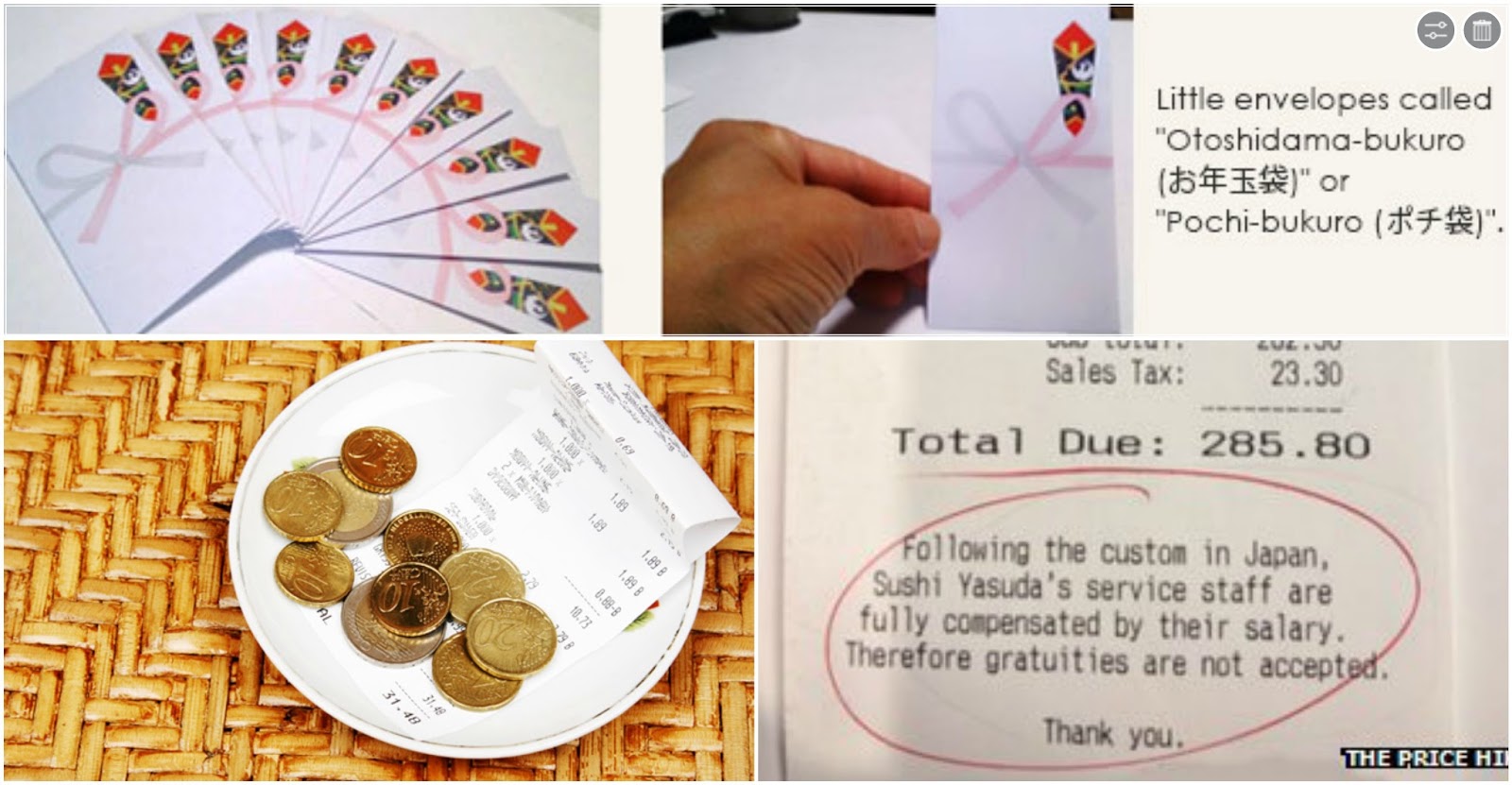
Tip me if you can! - Good services without tips

We all love getting the recognition we deserve when doing a good job at work, and most of us would accept tips whenever the opportunity presents itself. Here in Australia tips are usually reserved for service orientated tasks and the situations in which tips are expected may vary. For example, you might not always tip when ordering your morning coffee, despite the tip jar unless you’re a regular and are having a good day. But when catching a cab and having a nice chat with the driver or having a business meeting in a fancy restaurant you may feel more inclined to tip – and it’s perfectly acceptable. However in Japan (and in many Asian countries) tipping someone for their good service isn’t as easy and effortless as you would expect it to be.

The Japanese believe that good service is the standard (as it should be) and so they embrace that customers should not pay extra. The custom of tipping is a bizarre one to them, because as the saying goes ‘The customer is king’. However if you really feel that your host deserves a tip, you may place the tip in a small envelope called otoshidama-bukuro or pochi-bukuro and offer it in this way. And to further express your gratitude - why not tell them? You can say ‘kore wa kimochi desu’ which roughly translates to 'I appreciate you' or in this instance, 'your service'. However in most cases if you were to leave the cheque on the table along with a tip, you just might be seeing your waiter chasing you down. So good luck finding an average and honest Japanese person that would even think of accepting your tip.

 In addition, like any business environment, competition with others which have similar quality and price level, differentiation is important. Restaurants and hotels focus on improving services for customers. On the other hand, competitors also develop services to win over customers so this makes synergistic effect on better services.

Friday, 18 September 2015

Onsen - Taking a Dip!

Japanese Onsen (Natural Hot Spring)
Occasionally we all love a good soaking  in the tub just to relax and break away from the routine showers and daily rushes, but in Japan it’s on a whole new level. Or rather an older one - a much older one. Japan is known for many hot springs and the Japanese have embraced them since the early 1600’s. The abundance of this natural geothermal resource is the very definition of tranquillity, relaxation and socialization. Onsen is the Japanese word for ‘natural hot springs’ and the resorts that been built around them. There is believed to be over 2,500 onsen and many have been preserved because Japanese people love taking a dip in them. It is strongly believed that onsen wield health benefits as they are naturally composed of a plethora of minerals – which also have their own curious properties.


Onsen are a special place to socialize with others, and unlike the usual spas, pools, hot tubs, or even beaches you may be used to going to, Japanese onsen have similar yet slightly more peculiar rules. It is usually frowned upon not to fully disrobe – meaning yup you guessed it – if you’re not getting nude, you sure are being rude! But before you worry too much, just remember that this is a part of their culture and that there are some onsen resorts which are private and cost a little more. Japanese love taking a dip as regular as once a month to twice a week.

Pushing the social etiquette aside, you can find onsen with black, blue, green, smoky-white, blood-red, and rustic-brown coloured waters which derive from the variations of those fantastic minerals. But don’t hesitate to try it just yet – the minerals are all safe enough to soak in. Of course those coloured onsen are usually based on the terrain they are found in – and that applies to their respective minerals too.
Blood-Red_Smoky-White_Rustic-Brown_Black_Blue Osen
Mountainous terrain usually holds the best views to relax while in a hot spring. Those onsen in the mountains usually contain sulphur and are pretty much the most common type of hot spring in Japan. Rotenburo-onsen is roughly translated to outdoor hot springs.

Green Onsen - Delicacy Hard Boiled Eggs
The numerous health benefits include the aiding of circulatory, digestive, or neurological disorders to muscular, joint or skin problems. But that’s not the curious part per se. A half hour session will both relax you and tire you out as  it supposedly consumes the same amount of energy as running 1,000 meters at full speed, and bathers are advised to rest sufficiently and replenish fluids after bathing. Some of the resorts offer hard boiled eggs hot spring style...and it is delicacy! It is no wander the Japanese have a knack for inventing great things! They are always so relaxed and rejuvenated! 

Check out these links for more detailed information on Onsen:


Wednesday, 16 September 2015

'Sealing' the deal? Sorry we don't take...Signatures???

In western society culture we are accustomed to using signatures to authorise a payment, enter a contract, or simply just to declare that you have received that package you have been waiting for from the courier at your doorstep. And if you’re a business man or woman chances are you are familiar with business stamps containing a whole lot of general information about the company name, contact details, address etc. But did you know that in Japan, the use of stamps are a mandatory replacement of the traditional signature?

The use of a personal name stamp called Hanko is common practice for all Japanese who are signing an official document. The term, meaning ‘seal’ is interchangeably used with Inkan – which also roughly translates to stamp or ‘seal’. So how did this all come about? In old times, the government enforced the law to use the seal without signing because some people were illiterate.

Getting your hands on a Hanko is quite easy as they are available from the 100 Yen store – don’t worry 100 Yen is just over one Australian Dollar. The Inkan is a stamp of the holders’ surname – mandatory for the Japanese. And it’s for this reason that you can obtain one in the 100 Yen store – because there are a lot of common last names. Custom-made Inkan can be made for those who can’t find what they’re looking for (which is basically their name). Weird right? But hey! Don’t forget that in Australia we can buy novelty plates with common names on them from the local news agency.


If you’re asking yourself how can buying a cheap signature stamp be as assuring as a unique, traditional identifying signature? Rest assured because more important documents require more identifying information alongside your Inkan. If you plan to visit Japan for the short-term, you don’t need a Hanko and can sign instead. But as the saying goes…monkey see, monkey do!

If you wold like to read more about the uses of the Hanko/Inkan check out the links below.


Saturday, 12 September 2015

Bowing Etiquette – Are you doing it right?

The Saikeirei
Have you noticed that in Japan they bow differently in particular circumstances and each of these have different meanings? This gesture is likely to be used as greeting, showing respect to people or apologizing, ranging from a slightly nod of the head to deep bend at the waist.

When you were in higher position than others, u would probably feel that people talk to you more politely, they may bow deeper than normal and maybe order the same food you do at the restaurant. It sounds new to you, right? It is because not only Japan, but almost all Asian cultures, we have societal ranking, and we rely on that to behave appropriately. This is practiced in both daily life and business situations.

If you planned to join the working environment in Japan, a 45 degree bow of the upper body (called Saikeirei) is the thing you have to do when your boss gets angry at you. Moreover, this could be used in situations you need to apologize and show regret. 

In regards to bowing in business context, I would like to mention a bit how they exchange the business cards. You have to give both hand and do as the diagram.
You might have noticed that in Asian cultures expressing your thanks verbally or greeting someone with a simple ‘Hello’ doesn’t account for the majority of the people (especially in those Japanese classic films from a decade ago). Instead, normally a slightly nod of the head does the trick. Take me as an example, this morning a gentleman offered me his seat and so I slightly nod my head to express my gratitude and smiled.

To sum it all up, it is great if you know how to bow and do it naturally, otherwise if you can’t get the hang of matching the bow to the occasion....no worries. The Japanese do not expect foreigners to do so. However, if you don’t know it, just don’t do it. Don’t put yourself in this ridiculous situation.

President Obama and Emperor Akihito

President Obama didn’t know whether he should shake or bow, then he ended up with a bow-handshake. Thankfully this little mishap in November 2009 with the Emperor of Japan, Akihito, was completely forgivable and laughable distant memory.


Tuesday, 1 September 2015

Chasing a diverse Culture... Japan and it's Intrigue!

Around the world it is mostly understood that if you are a part of a religion you are likely to stick to the cultural beliefs and moreover celebrations! Australia is regarded as one the largest multicultural hot-spots in the world and we embrace the many different cultural events throughout the year. Our adoption of events such as the Holi Festival of Colours (originating form India) - and giving it an Aussie twist thus molding it into the annual Color Run! And the New Years Eve celebrations on the Sydney Harbor Bridge paints the picture of a diverse culture. However, across the globe Japanese people have ‘multi-religions’.
The Color Run...the Aussie adoption of India's Holi Festival!
Indeed, they combine cultural and religious aspects of Buddhism and Christianity. For example, their weddings take Christian style but their funerals take Buddhism style (Till Death Do Us Part, right?).They visit the shrines for New Year’s good luck though they celebrate Christmas. So...why does this bizarre thing happen? Why embrace multiple aspects of the different paths?
The thing is because many Japanese people aren’t willing to learn the doctrines by entering a specific religion. Instead of that, they worship ancestors. They think ancestors look after people who are alive today even though they’ve already passed away. 
Traditional Christian Wedding in Japan


Christmas in Japan - Light em Up!


A traditional Buddhist Funeral Shrine


For a more detailed view on the topic visit these great links: